



Chapter 01
Trends don’t deserve budget. Outcomes do.
The question is never whether technology is impressive. It is whether your guests and staff will feel it.
Hotel technology in 2027 is dominated by AI: guest messaging, dynamic upsell, agentic back office tools, voice in the room. Some of it is genuinely useful. Some of it is a demo in search of a problem. The difference rarely lies in the technology and almost always in the filter you apply before spending. Our filter is simple: guests or staff must feel the difference, it must integrate with the PMS and the operation, your data must stay governed, and the result must be measurable within a season.
That filter sounds obvious. In practice it is rare. Budget season rewards whoever tells the most exciting story, and AI vendors tell excellent stories. The demo shows a guest asking for a late checkout in Japanese and getting a perfect answer in seconds. What the demo does not show is the integration with your PMS, the training on your actual rate rules, the handover to a human when the model is unsure, or the member of staff who now maintains the knowledge base next to their day job.
We see the same pattern across hotel groups every year. A tool gets bought in November, implemented in March and quietly abandoned by August. Nobody measured anything, so nobody can say what went wrong. The licence renews anyway, because cancelling requires a conversation nobody owns. Multiply that by three or four tools and the innovation budget is gone before anything reached a guest.
Why budgets get wasted
The demo looks great
The vendor promises ROI
A competitor mentioned it
Fear of missing out does the math
Why pilots succeed
Guests or staff feel the difference
It integrates with PMS and operation
Your data stays governed and secure
Results measurable within one season
Everything that follows in this piece is the second card, applied to the 2027 landscape.
Chapter 02
Our 2027 hotel AI shortlist, honestly sorted
Three buckets, plus the one thing that comes before all of them.
The contactless journey
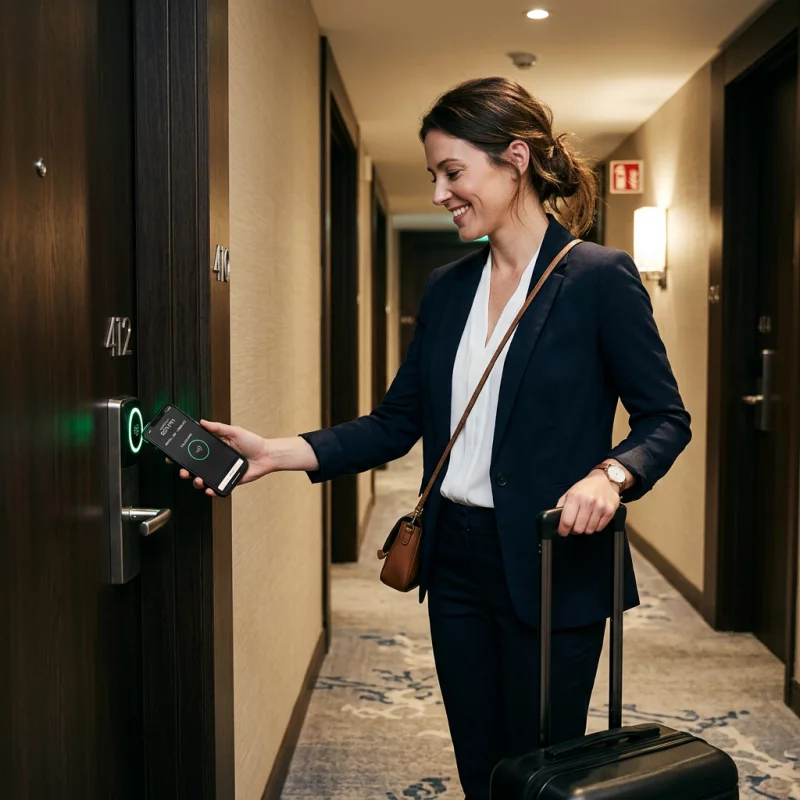
Mobile key, online check in and self service kiosks are past the pilot stage: guests expect the option and staff gain time for guests who want attention. For a 120 room property the arithmetic is straightforward: if a third of arrivals check in on their phone, the Saturday evening queue shrinks and the front desk becomes a place for questions instead of paperwork. The same discipline applies here as anywhere else: a kiosk is only as smooth as the PMS integration behind it, and every manual workaround at the front desk undoes the minutes it was meant to save. Alongside it, keep the network refresh moving. Contactless only feels contactless when the WiFi holds and the door locks respond first time, so treat the network as part of the same investment. Everything below runs on it.
AI in guest contact & back office
AI guest messaging that answers routine questions well, dynamic upsell in the booking flow and agentic tools that draft rosters and reports. Real value, real integration work. The honest caveat: none of these tools work out of the box. Guest messaging is only as good as the knowledge you feed it, and upsell only converts when the rate structure in the PMS is clean. Plan for the human side as well. Someone has to own the knowledge base after week one, review the answers the model gives and decide when a conversation moves to a person. Guests forgive a chatbot that hands over quickly. They are far less forgiving of one that keeps them trapped in a loop. The same goes for the back office: a roster drafted by a tool still needs a manager who checks it against reality before it publishes. Budget the integration hours and the ownership hours, not just the licence. Then pilot one, measure a season, and decide.
Voice, robots & the metaverse leftovers
In room voice assistants, service robots and immersive gimmicks keep returning to trade shows. Guest enthusiasm remains thin and integration costs remain thick. The pattern is familiar from a decade of in room tablets: high novelty in week one, low usage by month three, and a maintenance contract that outlives the excitement. There are exceptions, usually in tightly defined niches at very large properties, but they prove the rule rather than break it. If a genuine use case emerges, it will still be there in 2028, cheaper and better integrated. Waiting costs you nothing.
Let others fund the learning curve. Your budget belongs where guests and staff feel it.
The foundation
AI raises the value of your data and the cost of losing it. A chatbot with access to reservation data is a new door into your PMS, and it should only open once identity, access and monitoring are in order. Ask four questions before any pilot starts: which data does the tool read, where is that data processed, who can see the conversations, and how is access revoked when the pilot ends. A vendor who answers those questions quickly and in writing is a vendor you can work with. One who needs three weeks and a legal review to explain where your guest data goes has answered a different question. Security, identity and segmentation come before any AI pilot touches guest information. NIS2 makes the same point with fines, as covered in NIS2 is live.
Chapter 03
Discipline in three numbers
How to keep the innovation budget honest.
Every hotel group we work with has an innovation story. Far fewer have innovation discipline. The difference is not enthusiasm or intelligence. It is a small set of rules, agreed before budget season, that decide what gets funded and what gets a polite no. We recommend three numbers. Write them down, put them in the budget memo and let them do the arguing for you.
One pilot at a time
Run one AI pilot at a time per domain. A guest messaging pilot and a rostering pilot can run in parallel, because they touch different teams and different metrics. Two guest facing pilots at once cannot, because when satisfaction moves you will not know which tool moved it. One pilot means clean attribution, one owner and one honest verdict.
Ninety days to a verdict
Every pilot gets ninety days from go live to decision. Long enough to cover a realistic slice of the season, short enough that the organisation stays interested. On day ninety the owner presents the numbers against the target that was set at the start. The verdict is scale, stop or one defined extension with a new date. A pilot without a deadline is not a pilot. It is a subscription.
Full first year cost, counted up front
Before anything is signed, put the complete first year on paper: licences, integration hours, training, the staff time that maintains content and the exit cost if it stops. Vendors quote the licence. Operations pay the rest. A tool that looks affordable per room per month often looks very different once the real hours are counted, and it is better to discover that in a spreadsheet than in the third quarter.
Three numbers, one page. When a new tool appears mid year, and it will, the answer is already written: it joins the shortlist for the next cycle, or it displaces the current pilot on merit. Either way, the budget stays honest and the team stays focused.
Chapter 04
How to run an AI pilot that produces a decision
The outcome of a pilot is a yes or a no. Never a shrug.
With IT Strategy & Project Services we help hotel groups baseline their estate, choose pilots against the filter and run them with metrics, so the budget conversation next year starts with results instead of impressions.
Baseline
Confirm the foundation: network, security and data governance ready. If the WiFi drops in the west wing or vendor accounts share passwords, fix that first. A pilot on a shaky foundation measures the foundation, not the tool. The check itself is not glamorous, but it is fast: a network that holds under a full house, accounts that belong to named people, and a clear answer to where guest data lives. Most properties can close those gaps in weeks once they are named, and every later pilot inherits the benefit.
Pick one
Choose one pilot against the four filter criteria. Park the rest on a written shortlist with a date for the next decision. Saying not yet is much easier when everyone can see when yes becomes possible. The shortlist matters as much as the choice: a parked tool with a review date attached stops resurfacing in every meeting as a new idea, and the team whose favourite was parked stays engaged because the decision was postponed on the record instead of dismissed in a hallway.
Pilot with metrics
Ninety days, one property, one owner, one measurable target. Define the target before go live: minutes saved at the front desk, upsell revenue per arrival, response time on guest messages. If nobody can name the number, the pilot is not ready to start. Then keep the measurement boring and public. A shared page with the weekly number does more for adoption than any launch presentation, because everyone can see whether the tool is earning its place, and the verdict on day ninety surprises no one.
Scale or stop
Results decide. Scaling gets a roadmap slot, budget and a rollout plan per property. Stopping gets no shame and a one page note on what was learned, so the next evaluation starts smarter than this one did. Both outcomes are wins. The expensive outcome is the third one: a tool that lingers half used because nobody wants to own the verdict, quietly renewing while the organisation looks away.
A pilot that ends in a shrug costs more than a pilot that ends in a no.
The annual rhythm matters: one or two decisive pilots per year compound faster than a portfolio of maybes. A group that runs this rhythm for three years ends up with a short list of tools that demonstrably work, and a reputation among staff that new technology arrives ready. That reputation is worth more than any single feature.
Chapter 05
The best tech strategy fits on one page. So should the budget.
The winning move for 2027 is not more technology. It is a foundation and a filter.
Hotels don’t win by adopting the most technology. They win by adopting the right technology on a foundation that never breaks the guest experience. That foundation, and the partner who owns it, is the real 2027 decision. Read why hotels need a hospitality MSP, and how to keep the investments plannable in IT without a roadmap surprises your CFO.
That one page should state what the foundation costs, which one or two pilots run this year, what number each pilot must hit and who owns the verdict. A board can read it in five minutes. A vendor can be measured against it in one meeting. And when the next impressive demo arrives, the page answers before the room gets excited.